
OpenAI Unveils GPT-5.5: The AI Model That’s Redefining What Machines Can Do
A new era of smarter, faster, and more capable artificial intelligence has arrived.
In a move that underscores the intense rivalry in artificial intelligence, OpenAI announced the release of GPT-5.5 on Thursday, April 23, 2026—just seven days after competitor Anthropic launched Claude Opus 4.7. Codenamed “Spud” internally, this latest iteration from OpenAI represents far more than an incremental update. It’s a complete ground-up rebuild and signals how leading AI companies are rapidly innovating to set new standards in the field: moving beyond answering questions toward enabling AI systems that can autonomously accomplish complex tasks.
“This is a new class of intelligence,” Greg Brockman, OpenAI’s co-founder and president, told reporters during a briefing. “It’s a big step towards more agentic and intuitive computing.” His words aren’t marketing hyperbole. Early testing suggests GPT-5.5 might be the first AI model that truly feels like a collaborator rather than a tool.
The Race That Never Sleeps
The release comes just six weeks after OpenAI debuted its previous model, an extremely fast turnaround that underscores how fiercely frontier AI labs are competing for enterprise customers. The AI industry has entered what some observers are calling a “breakneck pace” of development, with major labs releasing increasingly powerful models at intervals that would have seemed impossible just a year ago.
The timing is particularly notable given the competitive landscape. The launch comes less than two months after OpenAI released GPT 5.4, and just weeks after Anthropic unveiled Claude Mythos Preview, its new model with advanced cybersecurity capabilities. While Mythos has been restricted to a limited audience due to safety concerns, the competitive pressure it represents is unmistakable.
OpenAI also revealed impressive user statistics: 4 million active Codex users, 9 million paying business users on ChatGPT, more than 900 million weekly active users, and over 50 million subscribers. These numbers appear designed to counter recent narratives suggesting the company had lost momentum to competitors like Anthropic.
What Makes GPT-5.5 Different
Unlike the incremental updates that characterized previous releases, GPT-5.5 is the first fully retrained base model since GPT-4.5. Every model released in between was built on the same architectural foundation. This one started from scratch.
The most striking improvement lies in what OpenAI calls “agentic” capabilities—the model’s ability to work autonomously through complex, multi-step tasks. Instead of carefully managing every step, users can give GPT-5.5 a messy, multi-part task and trust it to plan, use tools, check its work, navigate through ambiguity, and keep going.
Mark Chen, chief research officer at OpenAI, said the model “shows meaningful gains on scientific and technical research workflows,” noting that the company feels it could really “help expert scientists make progress”. This isn’t just about writing better emails or summarizing documents—GPT-5.5 is being positioned as a tool that can accelerate cutting-edge research.
According to OpenAI, the model excels at writing and debugging code, researching online, analyzing data, creating documents and spreadsheets, operating software, and moving across tools until a task is finished. The key phrase there is “until a task is finished”—previous models often required constant human guidance to complete complex workflows.
Speed Without Sacrifice
One of the most impressive technical achievements is that GPT-5.5 delivers dramatically increased intelligence without the latency penalty typically associated with larger, more capable models. GPT-5.5 matches GPT-5.4 per-token latency in real-world serving, while performing at a much higher level of intelligence.
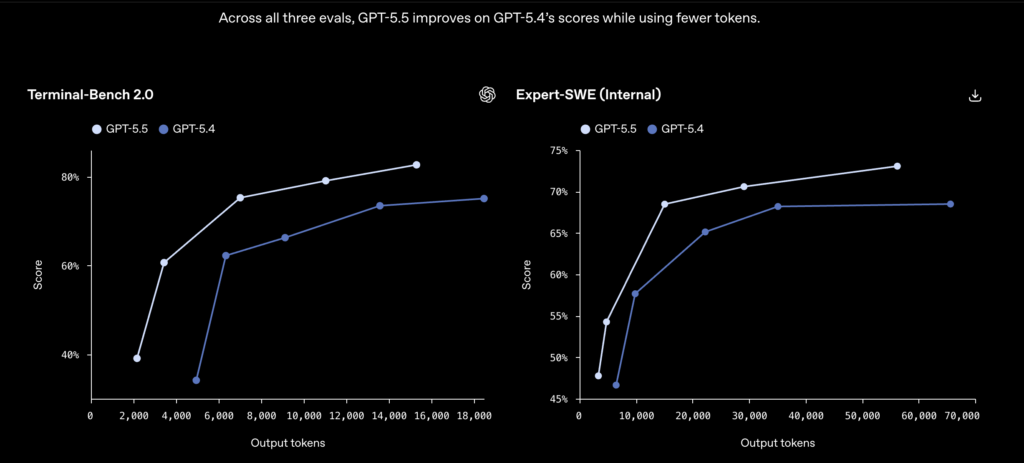
Even more remarkably, the model is more efficient. It uses significantly fewer tokens to complete the same Codex tasks, making it more efficient as well as more capable. For businesses paying for AI services based on token usage, this translates directly to cost savings—you get better results for less money.
On Artificial Analysis’s Coding Index, GPT-5.5 delivers state-of-the-art intelligence at half the cost of competitive frontier coding models. That’s not just an incremental improvement; it’s a fundamental shift in the economics of AI deployment.
This efficiency gain was achieved through deep hardware-software co-design. The model was co-designed with NVIDIA’s GB200 and GB300 NVL72 rack-scale systems. The optimization was so thorough that GPT-5.5 itself helped improve the infrastructure that serves it—the AI literally helped build the systems that run it more efficiently.
Benchmark Dominance
The numbers tell a compelling story. On GDPval, which tests agents’ abilities to produce well-specified knowledge work across 44 occupations, GPT-5.5 scores 84.9%. These aren’t abstract academic exercises—they represent real-world tasks from finance to legal research to product management.
On OSWorld-Verified, which measures whether a model can operate real computer environments on its own, GPT-5.5 reaches 78.7%. This benchmark tests whether the AI can actually use a computer the way humans do—clicking, typing, navigating interfaces—and the results suggest we’re approaching a threshold where AI can genuinely work alongside humans in digital environments.
Perhaps most impressively, on Tau2-bench Telecom, which tests complex customer-service workflows, GPT-5.5 reaches 98.0% without prompt tuning. That near-perfect score on real-world customer service scenarios has immediate commercial implications.
The scientific capabilities are equally striking. On GeneBench, a new evaluation focusing on multi-stage scientific data analysis in genetics and quantitative biology, GPT-5.5 shows a clear improvement over GPT-5.4. These are problems that often correspond to multi-day projects for scientific experts—and the AI can now meaningfully contribute to solving them.
An internal variant of GPT-5.5 discovered a new proof about Ramsey numbers in combinatorics, a particularly notable achievement given that exact Ramsey numbers are notoriously difficult to compute and new results typically take decades of human effort.
The Long Context Revolution
One of the most significant technical breakthroughs involves long-context understanding. Previous models could technically handle large amounts of text, but their performance degraded significantly beyond about 128,000 tokens. GPT-5.5 changes that equation entirely.
GPT-5.5 holds up past 128K, past 256K, and all the way out to 1M tokens, making this the first OpenAI model where the whole context window is genuinely usable. Independent testing confirmed this claim—researchers fed the model nearly 300,000 tokens of SEC filings and asked it to retrieve specific facts buried at various depths throughout the documents. It succeeded.
On MRCR v2 at 512K-1M token contexts, GPT-5.5 jumps to 74.0% from GPT-5.4’s 36.6%—a 37-point improvement. This isn’t a marginal gain; it’s a qualitative leap that enables entirely new use cases. Processing entire codebases, large document sets, or multi-hour conversation logs is now genuinely feasible.
Real-World Impact
The abstract capabilities translate into concrete productivity gains. More than 85% of OpenAI employees use Codex every week across functions, including software engineering, finance, communications, marketing, data science, and product management. This internal adoption speaks volumes—the people building the technology trust it enough to use it for their own work.
The finance team at OpenAI provides a striking example. They used GPT-5.5 to review 24,771 K-1 tax forms totaling 71,637 pages, accelerating the task by two weeks. That’s not automation of simple, repetitive tasks—that’s handling complex financial documents that require understanding context and making nuanced judgments.
In the communications department, the team used GPT-5.5 in Codex to analyze six months of speaking request data, build a scoring and risk framework, and validate an automated Slack agent so low-risk requests could be handled automatically while higher-risk requests still received human review. This kind of sophisticated workflow automation was largely theoretical six months ago.
Early access partners reported similar transformations. Senior engineers found the model could gut-check complex work, review thousands of additional documents, and save up to 10 hours per week. One example: a math professor used GPT-5.5 and Codex to build an algebraic geometry app from a single prompt in 11 minutes.
The Safety Challenge
The impressive capabilities come with significant responsibilities, and OpenAI is acutely aware that more powerful AI systems require stronger safeguards. OpenAI evaluated the model across its full suite of safety and preparedness frameworks, worked with internal and external red-teamers, added targeted testing for advanced cybersecurity and biology capabilities, and collected feedback on real use cases from nearly 200 trusted early-access partners before release.
The cybersecurity dimension is particularly sensitive. While GPT-5.5 does not cross the “Critical” cybersecurity risk threshold, which could bring “unprecedented new pathways to severe harm,” it does meet the criteria for the “High” risk classification, which could “amplify existing pathways to severe harm”.
Mia Glaese, OpenAI’s vice president of research, emphasized that “GPT-5.5 underwent extensive third-party safeguard testing and red teaming for cyber and bio risks, and we’ve been iterating on our cyber safeguards for months with increasingly cyber capable models”.
OpenAI first introduced cyber-specific safeguards with GPT-5.2 last year, which have continued to be tested, refined, and built upon in subsequent deployments. For GPT-5.5, the company designed tighter controls around higher-risk activity, sensitive cyber requests, and added protections for repeated misuse.
The approach represents a delicate balance—preserving access to beneficial capabilities while preventing misuse. Additional protections have been added around scaled agentic vulnerability research and exploit-chaining techniques, acknowledging that these capabilities could significantly accelerate both defenders’ efforts to secure systems and potential attackers.
The Competitive Landscape
The release puts OpenAI back in a leadership position after weeks of intense competition. On Terminal-Bench 2.0, which tests planning, iteration, and tool coordination across command-line workflows, GPT-5.5 scores 82.7% versus 69.4% for Claude Opus 4.7, the flagship model from competitor Anthropic.
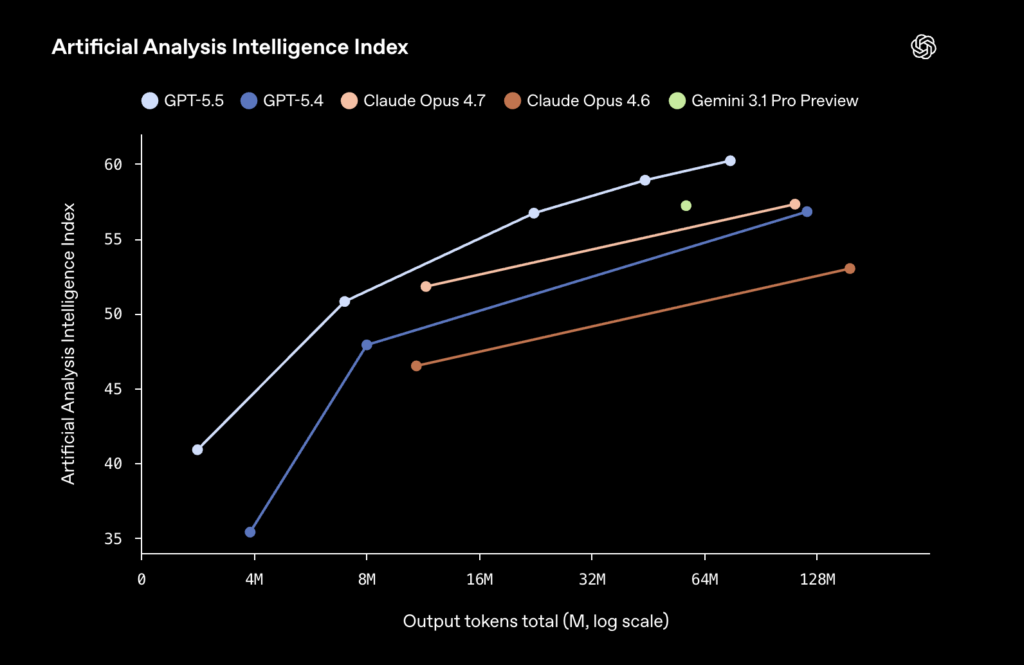
However, the competition remains fierce and nuanced. On certain benchmarks, particularly those involving pure academic knowledge without the use of tools, Anthropic’s models still hold an advantage. The real story isn’t about a single winner—it’s about an ecosystem of increasingly capable systems pushing each other forward at an unprecedented pace.
NVIDIA’s vice president of enterprise computing, Justin Boitano, noted that GPT-5.5 can act as a “chief of staff,” helping power agents that are already acting as employees at NVIDIA. The model has moved beyond being a productivity tool to becoming an active participant in workflows.
Access and Availability
GPT-5.5 is rolling out to OpenAI’s paid subscribers, including its Plus, Pro, Business, and Enterprise users, in ChatGPT and Codex. The company initially held back API access while implementing additional safeguards for scaled deployment, though API access was subsequently made available on April 24, 2026.
The Pro tier, priced at $100 per month, provides five times more Codex usage than the $20 per month ChatGPT Plus plan, targeting users who need extended sessions for complex work.
What This Means for the Future
Brockman said the new model brings OpenAI one step closer to creating the company’s “super app,” describing it as “a real step forward towards the kind of computing that we expect in the future”. The vision is clear: AI systems that don’t just assist with computing but fundamentally transform how we interact with computers.
“We are moving to a compute-powered economy,” Brockman added, referring to the idea that work will be powered by AI capacity, and therefore, compute will become the bedrock of the economy. It’s a bold claim, but one that’s becoming harder to dismiss as these systems demonstrate increasingly sophisticated capabilities.
The implications extend far beyond software engineering. If GPT-5.5 can genuinely contribute to scientific research, accelerate drug discovery, handle complex financial analysis, and operate computer interfaces autonomously, we’re looking at a technology that could reshape entire industries.
The question is no longer whether AI will transform knowledge work—GPT-5.5 suggests that transformation is already underway. The question now is how quickly organizations can adapt, how effectively we can deploy these capabilities responsibly, and whether the guardrails we’re building will prove sufficient for the systems we’re creating.
As Brockman noted, this is one step toward the future of computing, with many more expected to follow. If the pace of the past few months is any indication, we won’t have to wait long to see what comes next. The AI race shows no signs of slowing down—if anything, it’s accelerating.
Read more official documentation on https://openai.com/index/introducing-gpt-5-5/